
As an Amazon Associate, Gearaffiti earns from qualifying purchases. We did not test these scooters in person; this guide is based on maker specifications, published reviews and owner feedback. Always check local laws on minimum age and where e-scooters may be ridden.
An electric scooter gives teenagers real independence: a quick ride to school, practice or a friend’s house without waiting for a lift. For parents, the challenge is finding a scooter that is fun enough that teens actually use it, but not so fast or heavy that it becomes dangerous. The good news is that several popular scooters are built with sensible top speeds, beginner modes and even app-based speed limits.
This guide compares the best electric scooters for teens, explains which features matter for safety, and covers the rules every young rider should follow.
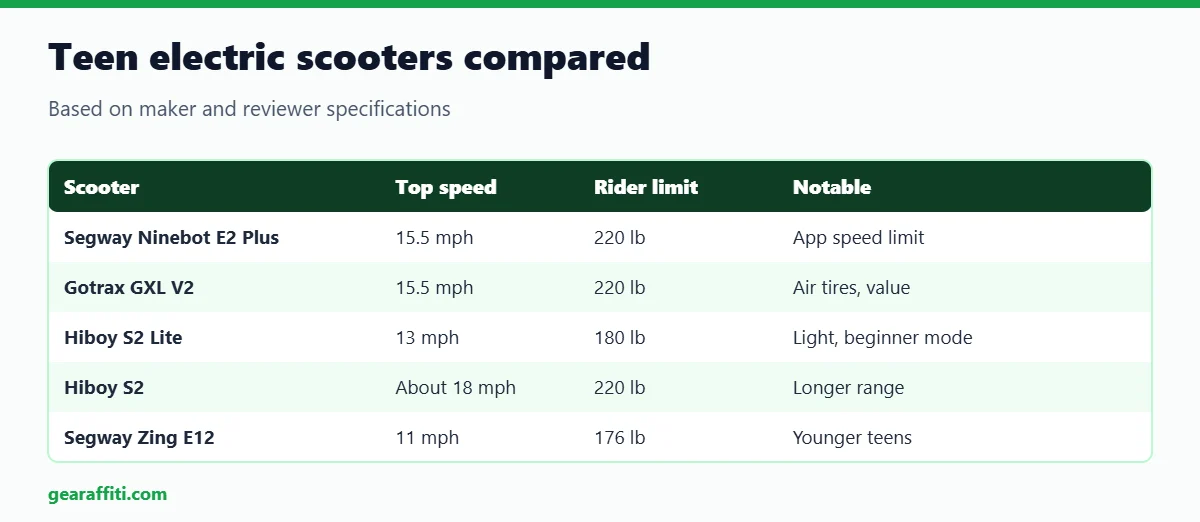
Table of Contents
Quick Picks
- Best overall: Segway Ninebot E2 Plus
- Best value: Gotrax GXL V2
- Best lightweight pick: Hiboy S2 Lite
- Best for longer rides: Hiboy S2
- Best for younger teens: Segway Ninebot Zing E12
1. Segway Ninebot E2 Plus
Best overall. Segway is one of the most trusted scooter brands, and the E2 Plus hits a sweet spot for teens. ScooterGearLab notes that Segway rates it at 15.5 mph and 22 miles of range, it supports riders up to 220 pounds, and its app lets a parent cap the top speed, which is the most useful feature for a new rider. The 220-pound limit means it can keep serving a teen as they grow.
Pros: parent-set speed limit, good range, trusted brand, grows with the rider.
Cons: costs more than budget models.
Check the Segway Ninebot E2 Plus on Amazon
2. Gotrax GXL V2
Best value. The GXL V2 is one of the best-selling budget scooters and a popular first scooter for teens. ZDNET lists a 15.5 mph top speed, about 12.5 miles of range, 8.5-inch pneumatic tyres and a 220-pound weight limit. Air-filled tyres give a noticeably smoother ride than solid tyres on rough pavements.
Pros: affordable, smooth air tyres, simple to use, widely available.
Cons: shorter range; air tyres can puncture.
Check the Gotrax GXL V2 on Amazon
3. Hiboy S2 Lite
Best lightweight pick. The S2 Lite is designed with younger riders in mind. Listings show a 250W motor, a 13 mph top speed with a slower beginner mode, UL 2272 certification, a weight of about 22 pounds and a range of around 10 miles. Its light weight makes it easy for teens to carry up steps, onto a bus or into a classroom. Note the lower 180-pound rider limit and small solid tyres, which feel firmer on bumpy ground.
Pros: light and portable, beginner speed mode, UL certified.
Cons: small solid tyres; lower rider weight limit; shorter range.
Check the Hiboy S2 Lite on Amazon
4. Hiboy S2
Best for longer rides. For older teens who commute farther, the full-size Hiboy S2 adds power and range. Listings show a 350W motor, a top speed of about 18 mph, a claimed range of around 17 miles, solid 8.5-inch tyres and a 220-pound limit. Its higher speed makes it better suited to experienced older teens.
Pros: longer range, more power for hills, puncture-free tyres.
Cons: heavier at around 35 pounds; faster than ideal for beginners.
5. Segway Ninebot Zing E12
Best for younger teens. The Zing E12 bridges the gap between kids’ scooters and adult models. ScooterGearLab describes it as built for ages 8 and up, with locked speed modes topping out at 11 mph and steering-sensitive speed control that slows the scooter in sharp turns. It is a sensible choice for 11- to 13-year-olds or smaller teens.
Pros: low top speed, safety-focused features, Segway build quality.
Cons: older teens will outgrow it quickly.
Check the Segway Zing E12 on Amazon
Match the Scooter to the Rider
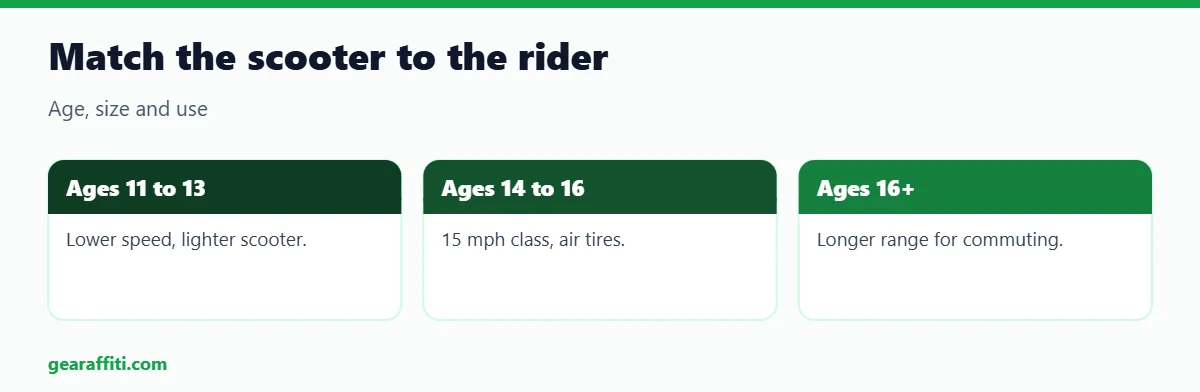
Ages 11 to 13: choose lower speeds (around 10 to 13 mph), lighter weight and beginner modes, like the Zing E12 or Hiboy S2 Lite.
Ages 14 to 16: the 15 mph class, such as the Segway E2 Plus or Gotrax GXL V2, gives enough speed for school trips while staying manageable.
Ages 16 and up: experienced riders who commute farther may suit higher-range scooters like the Hiboy S2. For bigger or heavier riders, see our guide to electric scooters for heavy adults.
Features That Matter for Teens
Speed limits and modes
Multiple speed modes let new riders start slow. App-based speed caps, like Segway’s, let parents set a maximum and raise it as skills grow.
Brakes
Look for at least two braking systems, such as an electronic brake plus a rear fender or disc brake. Practise emergency stops in a safe area.
Tyres
Air-filled (pneumatic) tyres absorb bumps and grip better; solid tyres never go flat but give a harsher ride.
Weight and portability
Teens often carry scooters into school or onto buses. Under about 30 pounds is easier to manage.
Safety certification
Choose scooters certified to UL 2272 for electrical and battery safety, especially since they will be charged indoors.
Hills
If your teen’s route is hilly, more motor power helps. Our guide to the best electric scooter for climbing hills covers stronger options.
Safety Rules for Teen Riders
Know the medical advice first. The American Academy of Pediatrics recommends that children under 16 should not ride e-scooters, and that every rider wears a helmet (HealthyChildren.org). Some cities also set a legal minimum age. If you decide a younger teen is ready, choose a low-speed model, set it to its slowest mode, and supervise their first rides closely.
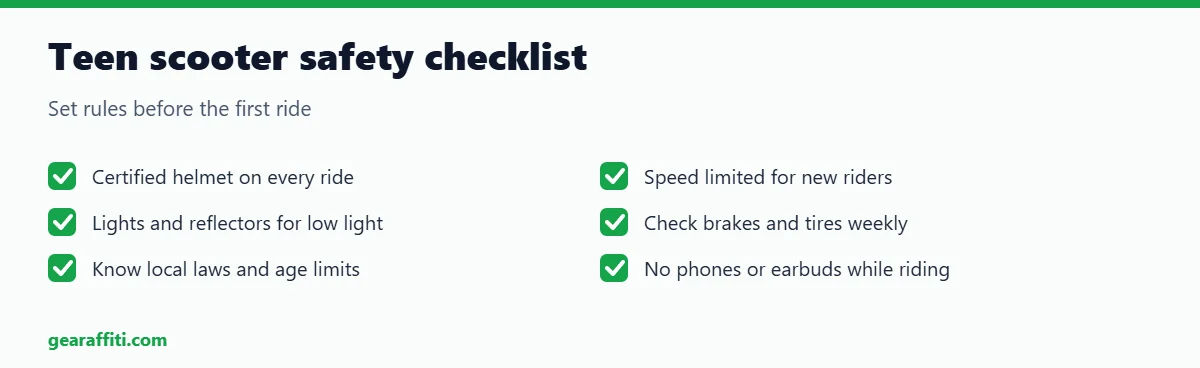
- Always wear a certified helmet. A dual-certified skate or bike helmet works well; see our guide to the best skateboard helmets.
- Start slow: practise in an empty lot before riding on paths or streets.
- Be visible: use lights at dusk and wear bright or reflective clothing.
- One rider only: scooters are built for one person.
- No phones or earbuds: riders need full attention and hearing.
- Know the law: many states and cities set minimum ages, speed limits and rules about riding on sidewalks or roads.
- Check the scooter weekly: brakes, tyre pressure, folding latch and lights.
How to Teach a Teen to Ride Safely
- Read the manual together: go over the controls, brakes, speed modes and folding mechanism before the first ride.
- Start in a quiet place: an empty parking lot, basketball court or quiet cul-de-sac is ideal for practising starting, stopping and turning.
- Use the slowest mode first: many scooters have a beginner or eco mode. Keep it there for the first few rides.
- Practise emergency stops: ask your teen to stop quickly on a signal, using both brakes smoothly without locking the wheel.
- Ride the route together: walk or ride the school route with them once to spot hazards like steep driveways, busy crossings and potholes.
- Agree on rules: helmet every time, no passengers, no stunts, no riding after dark without lights, and where they may and may not ride.
Battery Care and Charging Safety
Scooter batteries need the same care as phone and laptop batteries, only more so because they are larger. Charge with the original charger on a hard surface, away from beds, sofas and doorways, and do not leave a scooter charging unattended overnight. Avoid charging right after a ride while the battery is warm, and store the scooter indoors in moderate temperatures. If the scooter is dropped hard, the battery is damaged, or it smells or swells, stop using it and contact the maker. Choosing a UL 2272 certified model reduces battery and electrical risks.
Accessories Worth Adding
- Helmet with a light: adds visibility from behind. See helmets with lights.
- Bright front and rear lights: many built-in lights are weak; add-on lights help in low light.
- Phone mount: only for navigation, set up before the ride and never used while moving.
- Lock: scooters are easy to steal outside schools and shops. A compact U-lock or folding lock is best.
- Gloves and knee pads: useful for beginners and in colder months.
Electric Scooter vs Electric Skateboard vs E-Bike
For most teens, a scooter is the easiest electric ride to learn: you stand upright, steer with handlebars, and have hand brakes. Electric skateboards need more balance and skill, and braking takes practice, though they suit teens who already skate; see our guide to the best electric skateboards under $500. E-bikes handle longer distances and hills better and carry more, but cost more and are harder to store. For short school and neighbourhood trips, a scooter is usually the most practical choice.
Maintenance Basics
A few minutes each week keeps a scooter safe. Check tyre pressure on air tyres, look for cuts or wear, test both brakes, and make sure the folding latch locks firmly. Tighten loose bolts on the stem and handlebars, wipe off dirt, and avoid deep puddles, since most budget scooters are only splash resistant. Teach your teen to report any new noises, wobbles or brake changes so you can fix them early.
How Much Should You Spend?
Good teen scooters sit in a fairly narrow price band. Budget models from Gotrax and Hiboy usually cost a few hundred dollars and are fine for short trips on smooth pavement. Spending a little more on a brand like Segway buys better build quality, app controls such as speed limits, longer range and better after-sales support. Very cheap no-name scooters are best avoided for teens: they often lack safety certification, have weak brakes, and are hard to repair.
Remember to budget for safety gear too. A certified helmet, a lock and lights add to the total but make a big difference to safety and to how long the scooter stays in your family.
Is an Electric Scooter Right for Your Teen?
An e-scooter is a great fit if your teen has a short, safe route to school or activities, is responsible about rules, and has somewhere secure to store the scooter. It may not be the right choice if the route involves busy, fast roads without bike lanes, if local laws restrict scooter use for their age, or if there is nowhere safe to park it. In those cases, a regular bike or walking may be safer. If your family includes younger children who want to join in, our guide to toddler scooters covers safe options for little ones.
Frequently Asked Questions
What is a safe speed for a teen electric scooter?
For most new teen riders, around 10 to 15 mph is plenty. Use beginner modes or app limits, and increase speed only as skills improve.
What age can a teen ride an electric scooter?
It depends on local laws and the scooter’s age rating. Many adult-size scooters are rated for ages 14 and up, while models like the Segway Zing E12 suit younger riders.
Do teens need a license for an e-scooter?
In most US areas, no license is needed for low-speed e-scooters, but some states and cities set age limits or require helmets for minors. Check local rules.
How far can a teen scooter go on a charge?
Listed ranges run from about 10 to 22 miles for the scooters here, but real range drops with rider weight, hills and cold weather.
Are solid tyres or air tyres better?
Air tyres ride more smoothly and grip better; solid tyres are maintenance-free. For bumpy pavements, air tyres are more comfortable.
Can teens ride electric scooters in the rain?
Light rain is usually fine for scooters with a water-resistance rating, but wet roads reduce braking grip and visibility. Avoid deep puddles and heavy rain, slow down, and dry the scooter afterwards.
Should I buy a seated scooter for my teen?
Some scooters come with seats, which can help on longer rides. They are heavier and less portable, so most teens prefer a standing scooter for school trips.
Final Verdict
The Segway Ninebot E2 Plus is our top pick for teens thanks to its parent-set speed limit, solid range and room to grow. Choose the Gotrax GXL V2 for the best value, the Hiboy S2 Lite for a light scooter that is easy to carry, the Hiboy S2 for longer rides, and the Segway Zing E12 for younger teens. Pair any of them with a good helmet and a strong lock, such as those in our guide to the best e-bike locks.
Browse electric scooters for teens on Amazon

Hi, I’m Emam Hasan — an English teacher and the founder of Anirban Lexicon Center in Mirpur, Dhaka. I run Gearaffiti to share clear, honest buying guides on scooters, skateboards, longboards, bikes and snow gear. Alongside teaching, I work in digital marketing and SEO, and I enjoy turning spec sheets and owner feedback into simple advice anyone can follow.