
As an Amazon Associate, Gearaffiti earns from qualifying purchases. We did not test these helmets in person; this guide is based on maker certifications, safety organisation guidance, retailer listings and owner feedback.
Every skater falls, from first-day beginners to seasoned pros. Most falls end with scraped hands or a bruised hip, but a backward slam on concrete can be serious, which is why a good helmet is the most important piece of skate gear you can buy. The problem is that many “skate-style” helmets look the part without meeting any real safety standard.
This guide compares the best skateboard helmets, explains what the safety certifications mean, and shows how to get a fit that actually protects you.
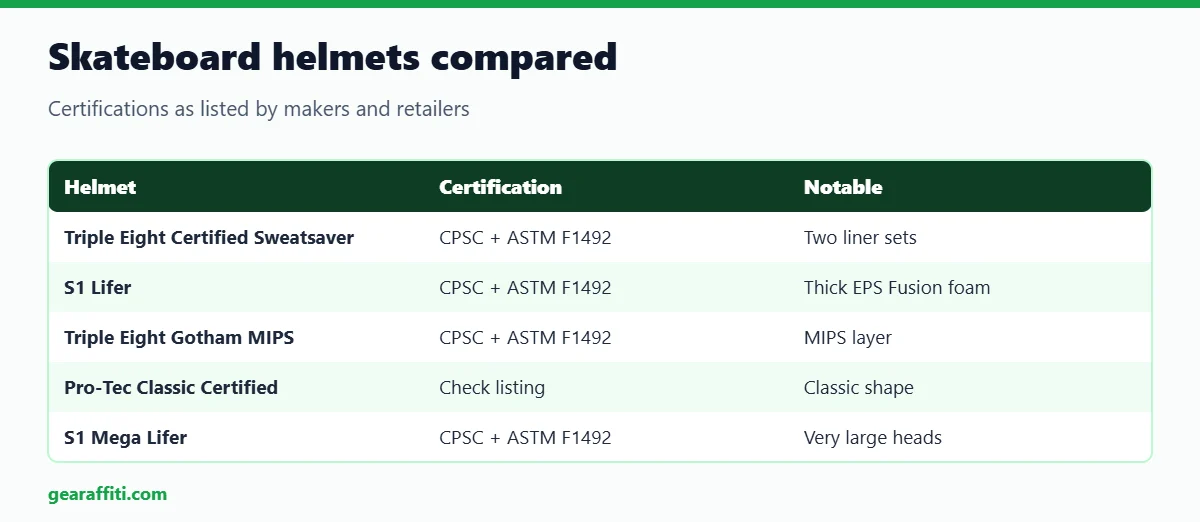
Table of Contents
Quick Picks
- Best overall: Triple Eight Certified Sweatsaver
- Best protection for hard slams: S1 Lifer
- Best with MIPS: Triple Eight Gotham MIPS
- Best classic style: Pro-Tec Classic Certified
- Best for big heads: S1 Mega Lifer
Skate Helmet Certifications Explained
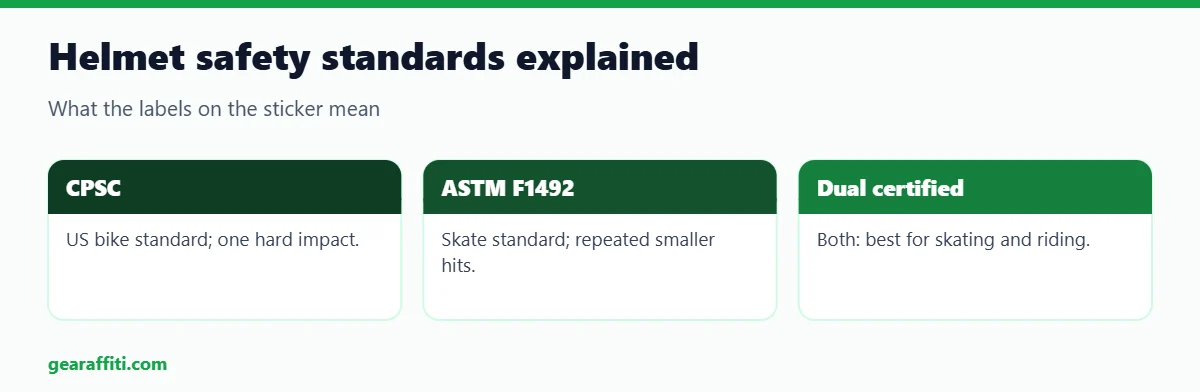
In the US, two standards matter most. CPSC is the mandatory standard for bicycle helmets and tests protection against a single, high-energy impact. ASTM F1492 is the skateboard standard, designed for repeated, lower-energy hits typical of skating. A helmet certified to both is called dual certified, and it is the best choice for skaters who also ride bikes or scooters.
The Bicycle Helmet Safety Institute warns that some “skate style” helmets are not certified to any skateboard standard, and that some brands use the phrase “dual certified” or “dually certified” for helmets certified to the CPSC bicycle standard and the European CEN standard, not to ASTM F1492. Always check the sticker inside the helmet for the exact standards.
1. Triple Eight Certified Sweatsaver
Best overall. The Certified Sweatsaver is one of the most popular skate helmets sold online. Triple Eight’s product page says it complies with both the US CPSC bicycle helmet standard for ages 5 and up and the ASTM F1492 skate standard, and includes two sets of Sweatsaver liners so you can fine-tune the fit. The moisture-wicking liner helps on hot days at the park, and the shell keeps the classic low-profile skate look.
Pros: dual certified, comfortable liner, two pad sets, affordable.
Cons: sizing can run small; measure your head carefully.
Check the Triple Eight Sweatsaver on Amazon
2. S1 Lifer
Best protection for hard slams. S1 builds helmets with a strong reputation among vert, bowl and downhill skaters. Retailers list the Lifer as certified to both CPSC and ASTM F1492 and built with S1’s thick EPS Fusion foam, which the maker says absorbs more energy than standard skate helmet foam. It has a deep fit that covers more of the back of the head, where many skate falls land.
Pros: thick, protective foam, deep coverage, dual certified, many colours.
Cons: bulkier look than low-profile helmets; costs more.
3. Triple Eight Gotham MIPS
Best with MIPS. MIPS is a low-friction layer inside the helmet that lets the shell move slightly on impact, designed to reduce rotational forces on the brain from angled hits. The Gotham adds MIPS to a dual-certified skate helmet, and it appears on the Bicycle Helmet Safety Institute’s list of helmets certified to both CPSC and ASTM F1492. It is a good choice for skaters who also ride bikes or e-scooters at speed.
Pros: MIPS protection, dual certified, adjustable fit.
Cons: heavier and pricier than basic helmets.
Check the Triple Eight Gotham on Amazon
4. Pro-Tec Classic Certified
Best classic style. Pro-Tec has made skate helmets since the 1970s, and its Classic shape is instantly recognisable at skateparks. Make sure you buy the Classic Certified, not the non-certified Classic, which is sold for style. As the Bicycle Helmet Safety Institute points out, Pro-Tec’s “dually certified” label has referred to CPSC and European standards rather than ASTM F1492, so check the listing and inside label for the exact certifications.
Pros: iconic look, comfortable low-profile fit, trusted brand.
Cons: certification varies by model; easy to buy the wrong version.
Check the Pro-Tec Classic Certified on Amazon
5. S1 Mega Lifer
Best for big heads. Many skaters struggle to find a helmet that fits a large head. SkatingMagic tested the S1 Mega Lifer in a 3XL size for heads up to about 25.5 inches and found it extremely roomy, with extra pad sets and dual ASTM and CPSC certification. If standard XL helmets feel tight, this is the one to try.
Pros: fits very large heads, thick foam, extra pads.
Cons: too big for average heads; bulky look.
Check the S1 Mega Lifer on Amazon
How a Skate Helmet Should Fit
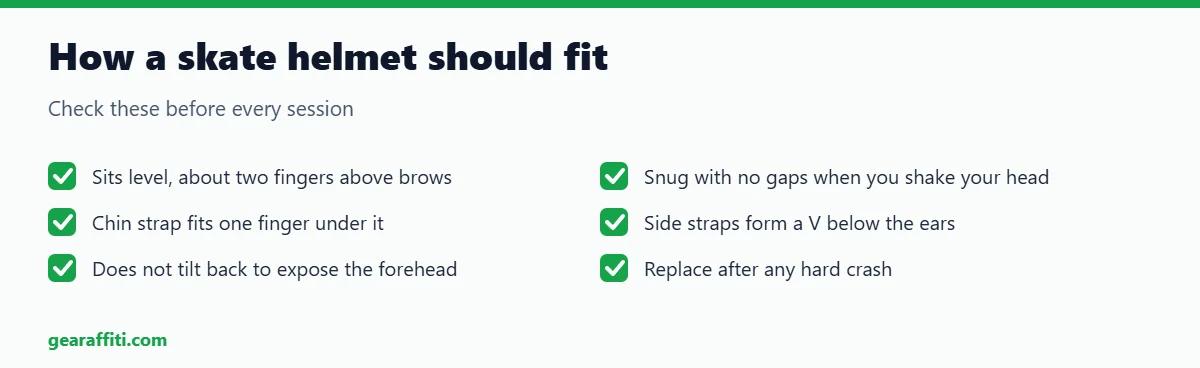
- Measure your head: wrap a soft tape measure around your head just above your eyebrows and ears. Use the maker’s size chart.
- Check the position: the helmet should sit level, with the front about two finger-widths above your eyebrows. A helmet tilted back leaves your forehead exposed.
- Test for movement: shake your head side to side and front to back. The helmet should move with your skin, not slide around.
- Adjust the straps: side straps should meet just below each ear in a V, and the chin strap should be snug with room for about one finger.
- Use the pads: swap thicker or thinner pads to fill gaps, rather than wearing a helmet that is too big.
When to Replace a Skate Helmet
Replace any helmet after a hard crash, especially CPSC-only helmets designed for one big impact. Even multi-impact ASTM helmets should be replaced if the shell cracks, the foam is crushed, or the helmet no longer fits snugly. Sun, sweat and age also break down materials, so many makers suggest replacing helmets every few years with regular use.
Other Protective Gear
Beginners and park skaters benefit from knee pads, elbow pads and wrist guards, which prevent the most common skate injuries. Learning to fall and stop safely also helps; see our guides on different ways to stop on a skateboard and where to learn to skateboard. See skate pad sets.
Helmets for Kids
Children should always wear a helmet, and many of the helmets above come in youth sizes. Choose a certified model, check the fit often as kids grow, and make the helmet a non-negotiable rule from day one. If your child is just starting out, our guides to skateboards for kids and the best skateboard for a 5-year-old can help you pick the right board.
Best Helmet by Riding Style
Street skating
Street skaters fall often but usually at modest speed. A low-profile, dual-certified helmet like the Triple Eight Sweatsaver offers protection without feeling bulky, and its sweat-wicking liner helps during long sessions.
Park, bowl and vert
Transitions and coping mean more backward falls and harder impacts on the back of the head. Deep-fit helmets with thick foam, such as the S1 Lifer, give extra coverage where it matters. Pair the helmet with knee pads you can slide on.
Cruising and longboarding
Cruisers and longboards often travel faster on roads and paths, so a dual-certified helmet is especially important. If you also ride bikes or scooters, choose one certified to CPSC. Our guide to types of longboards explains which boards suit cruising, carving and downhill.
Downhill and electric skateboards
At high speeds, consider a certified full-face helmet that protects the jaw and face. Electric skateboard riders should treat their helmet like a cyclist or moped rider would, since speeds can exceed 20 mph. See our guide to the best electric skateboards under $500 for boards where this matters.
Hard Shell vs In-Mold Construction
Most skate helmets use a hard ABS shell bonded over a foam liner. The tough shell resists scuffs and scrapes from repeated falls and gives the classic rounded skate look. Many bike helmets use in-mold construction, where a thin polycarbonate shell is fused to the foam, which saves weight and adds ventilation but scuffs more easily. For skating, a hard-shell helmet usually lasts longer, while in-mold designs suit long, hot rides where weight and airflow matter more.
Budget Options That Are Still Safe
You do not need to spend a lot to be protected. Brands such as OutdoorMaster and Triple Eight sell affordable helmets with dial-adjust fit systems. The key is certification: a cheap certified helmet beats an expensive uncertified one every time. Look for CPSC and, ideally, ASTM F1492 on the inside label, and avoid listings that only mention “meets safety standards” without naming them. See OutdoorMaster helmets.
Caring for Your Helmet
- Clean the pads: remove and hand-wash liners with mild soap, then air dry.
- Avoid heat: do not leave helmets in hot cars or direct sun for long periods; heat can weaken foam and shell.
- No solvents or stickers with strong adhesives: some chemicals can damage the shell.
- Store safely: hang it up or keep it in a bag so it does not get crushed under other gear.
- Inspect regularly: look for cracks, dents, loose straps and crushed foam.
Learning to Fall Safely
A helmet protects your head, but knowing how to fall reduces how often you need it. Experienced skaters learn to roll out of falls rather than putting out a straight arm, which is how many wrist injuries happen. On ramps, knee sliding on proper pads is the standard way to bail. Practise falling on grass or soft ground at first: crouch low, tuck your chin, and roll onto the fleshy parts of your shoulder and back. Keeping your chin tucked also keeps the back of your head off the ground in a backward fall.
Skating within your ability matters too. Learn the basics, including how to push, turn and stop, before trying hills, ramps or tricks. Our guide on how to turn on a skateboard covers one of the first skills to master, and how to grind on a skateboard is a good next step once you are confident.
Common Helmet Mistakes
- Wearing it tilted back: this leaves your forehead exposed in forward falls.
- Leaving the chin strap loose or undone: the helmet can fly off on impact.
- Buying a size up “to grow into”: a loose helmet offers poor protection, especially for kids.
- Wearing a hat underneath: it stops the helmet sitting snugly.
- Keeping a crashed helmet: damage to the foam is not always visible.
Frequently Asked Questions
Can I use a bike helmet for skateboarding?
A CPSC bike helmet is far better than no helmet, but it is designed for one big impact. A dual-certified skate helmet is better suited to the repeated falls of skating.
What does dual certified mean on a skate helmet?
Ideally, it means certified to both CPSC (bike) and ASTM F1492 (skate). Some brands use it for CPSC plus a European standard, so check the label.
Are MIPS skate helmets worth it?
MIPS is designed to reduce rotational forces in angled impacts. It adds cost and weight, but many riders feel the extra protection is worth it, especially for higher-speed riding.
How tight should a skate helmet be?
Snug enough that it moves with your scalp when you shake your head, but not so tight it causes pressure points or headaches.
How long does a skate helmet last?
Replace it after any hard crash or visible damage, and every few years with regular use as materials age.
Do I need a helmet for cruising on a penny board?
Yes. Small cruiser and penny boards can stop suddenly on cracks and pebbles, throwing riders forward. A certified helmet is just as important on a cruiser as on a full-size skateboard.
Are skate helmets good for scooters and bikes?
A dual-certified skate helmet that meets CPSC can be used for cycling and scooter riding as well, which makes it a practical single helmet for riders who do a bit of everything.
Final Verdict
The Triple Eight Certified Sweatsaver is our top pick for most skaters: dual certified, comfortable and affordable. Choose the S1 Lifer for maximum protection on ramps and bowls, the Triple Eight Gotham MIPS for added rotational protection, the Pro-Tec Classic Certified for timeless style (after checking its certification), and the S1 Mega Lifer if you have a large head. Whatever you choose, make sure it is certified and fits properly.
Browse certified skateboard helmets on Amazon

Hi, I’m Emam Hasan — an English teacher and the founder of Anirban Lexicon Center in Mirpur, Dhaka. I run Gearaffiti to share clear, honest buying guides on scooters, skateboards, longboards, bikes and snow gear. Alongside teaching, I work in digital marketing and SEO, and I enjoy turning spec sheets and owner feedback into simple advice anyone can follow.