
As an Amazon Associate, Gearaffiti earns from qualifying purchases. We did not test these goggles in person; this guide is based on maker specifications, published reviews and owner feedback. Prices change often, so check current listings.
Good goggles make a bigger difference to a day on the mountain than almost any other piece of gear. They protect your eyes from wind, snow and UV, and the right lens lets you see bumps and ice in flat light. Premium goggles from big brands can cost $200 to $300, but you do not need to spend that much. Several excellent goggles sell for under $100, including interchangeable-lens models that rival far more expensive options.
This guide compares the best snowboard goggles under $100, explains lens tints and fit, and shows how to stop fogging.
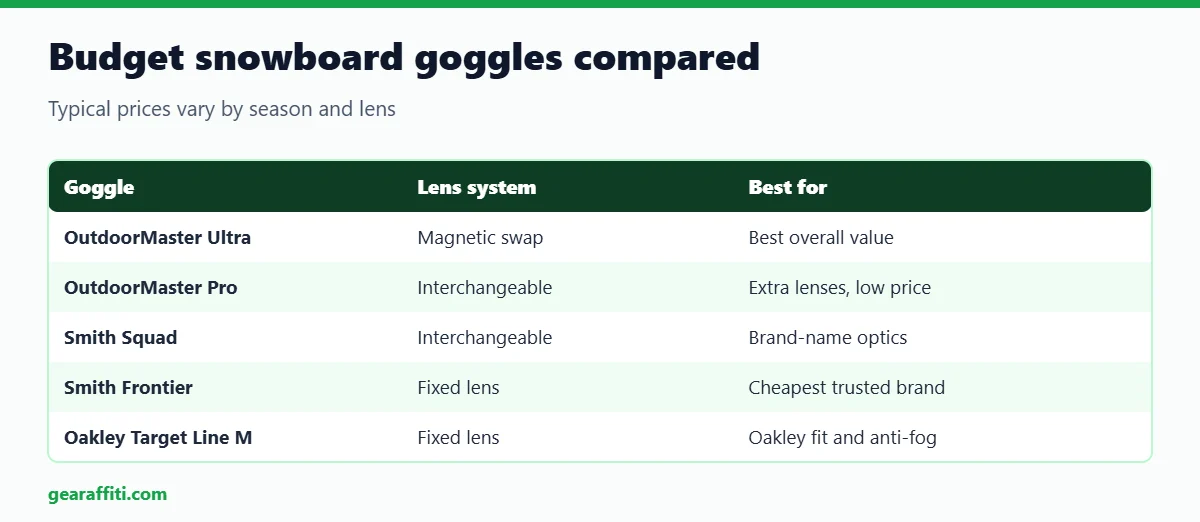
Table of Contents
Quick Picks
- Best overall value: OutdoorMaster Ultra
- Best for extra lenses on a budget: OutdoorMaster Pro
- Best brand-name pick: Smith Squad
- Cheapest trusted brand: Smith Frontier
- Best Oakley near $100: Oakley Target Line M
- Best over glasses: Dragon DX3 OTG
1. OutdoorMaster Ultra
Best overall value. OutdoorMaster built the Ultra to compete with goggles from Smith, Oakley and Anon at a much lower price. It has a frameless design for a wide, unobstructed view, magnetic interchangeable lenses, and an OTG-friendly frame that fits over most prescription glasses. SnowboardingDays rated it the best bang for the buck among budget goggles, noting it often drops under $100 on sale.
Pros: premium features for the price, quick lens swaps, wide view, OTG.
Cons: build quality not quite at the level of top brands; full price can be just over $100.
Check the OutdoorMaster Ultra on Amazon
2. OutdoorMaster Pro
Best for extra lenses on a budget. The Pro is cheaper than the Ultra but still includes interchangeable lenses, so you can switch between a dark lens for sunny days and a lighter lens for storms. It is a great first goggle for beginners who want flexibility without a big spend.
Pros: spare lenses included, low price, good field of view.
Cons: slower lens swaps than magnetic systems; less premium feel than the Ultra.
Check the OutdoorMaster Pro on Amazon
3. Smith Squad
Best brand-name pick. Smith is one of the most respected names in snow goggles, and the Squad is its long-running all-rounder. SportRx lists the Smith Squad at around $85, and many versions use Smith’s ChromaPop lenses, designed to improve contrast and colour definition. Some kits include a bonus low-light lens, which adds a lot of value.
Pros: trusted optics, medium fit suits many faces, ChromaPop options.
Cons: lens swaps are not magnetic; bonus lens depends on the kit.
Check the Smith Squad on Amazon
4. Smith Frontier
Cheapest trusted brand. If you want Smith quality at the lowest price, the Frontier is the goggle to look at. The Inertia named the Smith Frontier its best budget snowboard goggle. It has a simple fixed lens, so choose a tint that suits the conditions you ride most.
Pros: very affordable, reliable brand, many colourways.
Cons: fixed lens; basic features compared with interchangeable models.
Check the Smith Frontier on Amazon
5. Oakley Target Line M
Best Oakley near $100. The Target Line brings Oakley’s fit and F3 anti-fog coating to a lower price point. Prices vary by lens and colour, so look for sales to get it near $100. The M size suits medium faces, and an L version is available for larger faces.
Pros: Oakley optics and anti-fog, comfortable fit.
Cons: fixed lens; often priced above $100 outside sales.
Check the Oakley Target Line M on Amazon
6. Dragon DX3 OTG
Best over glasses. If you wear prescription glasses, an OTG (over the glasses) goggle has a deeper frame and cut-outs for your glasses’ arms. The Dragon DX3 OTG is an affordable OTG option; evo’s under-$100 goggle collection lists it at roughly $52 to $75 depending on colour.
Pros: fits over glasses, low price, reputable brand.
Cons: bulkier frame; fixed lens.
Check the Dragon DX3 OTG on Amazon
Choosing the Right Lens Tint
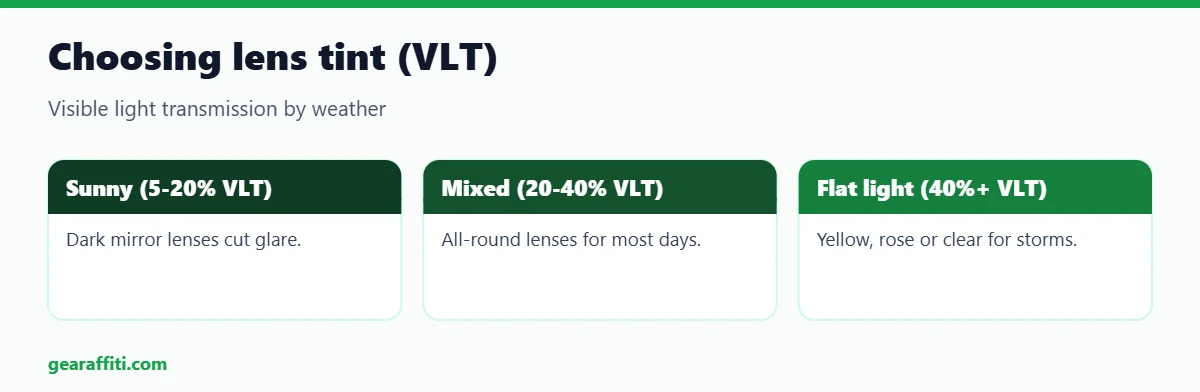
Lens tint is measured by VLT (visible light transmission): the percentage of light that reaches your eyes.
- Sunny days (about 5 to 20% VLT): dark, mirrored lenses cut glare off bright snow.
- Mixed conditions (about 20 to 40% VLT): versatile all-round lenses for partly cloudy days.
- Flat light and storms (40% VLT and above): yellow, rose or clear lenses boost contrast so you can see bumps.
If you can afford only one goggle, an interchangeable model with a sunny lens and a low-light lens covers almost every day on the mountain.
What to Look For
UV protection
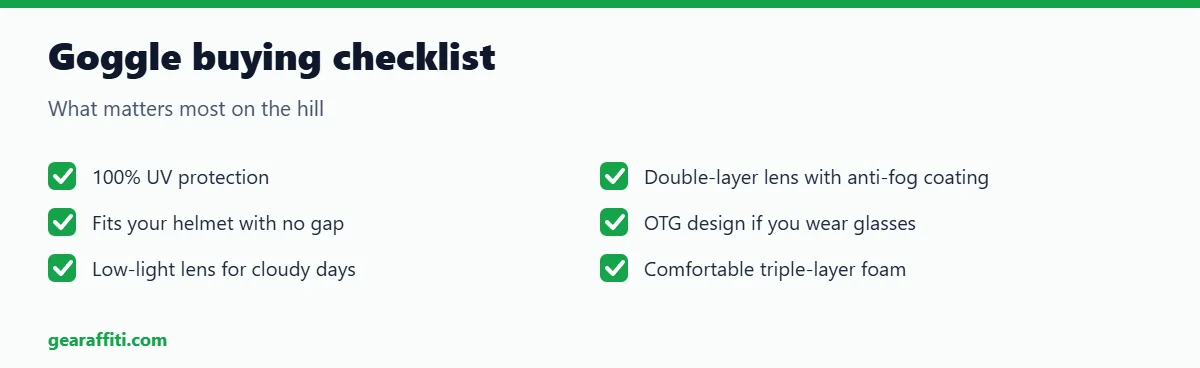
Snow reflects a lot of UV light. Any goggle worth buying should block 100% of UVA and UVB.
Anti-fog features
Look for double-layer lenses with anti-fog coating and good venting. Fogging is the most common complaint with cheap goggles.
Helmet compatibility
Your goggles should sit flush against your helmet with no gap at the forehead (sometimes called a “gaper gap”). Try them on together if you can.
Fit and face size
Medium-fit goggles suit most adults; small or youth sizes suit narrow faces and kids, and large frames give a wider view for bigger faces. Low-bridge or Asian-fit versions seal better on lower nose bridges.
OTG design
If you wear glasses, choose an OTG goggle so your glasses fit comfortably underneath without pressing on your nose.
How to Stop Goggles Fogging
- Keep them on your face: pushing goggles up on your forehead traps warm, damp air inside.
- Never wipe the inside lens: it removes the anti-fog coating. Let it air dry or dab gently with the supplied cloth.
- Keep vents clear: brush snow off the top vents and do not cover them with a hat.
- Dry them overnight: let goggles dry at room temperature, not on a heater.
- Keep moving: airflow while riding helps clear moisture.
Complete Your Snowboard Kit
Goggles work best as part of a full kit. If you are new to the sport, our guide to snowboards for beginners and types of snowboards will help you choose a board, and the best snowboard hoodies keep you comfortable on warmer spring days.
Lens Shapes: Cylindrical, Spherical and Toric
Cylindrical lenses curve from side to side but are flat from top to bottom. They are cheaper to make, give a classic look, and are common on budget goggles like the Smith Frontier and Oakley Target Line. Some riders notice slight distortion or glare at the top and bottom of the lens.
Spherical lenses curve both horizontally and vertically, like the shape of your eye. They usually offer a wider field of view, less distortion and better anti-fog performance because of the larger air space inside. Several budget brands, including OutdoorMaster, now offer spherical or frameless designs under $100.
Toric lenses combine both curves and are found mainly on premium goggles. They balance a wide view with a lower-profile look.
Frame Size and Field of View
A larger frame and lens give a wider field of view, which helps you spot riders and obstacles to the side. But a goggle that is too big for your face can leave gaps around the nose and cheeks that let cold air and snow in, and may not fit your helmet opening. Medium frames suit most adults. Riders with small or narrow faces, and most teenagers, are better served by small or “S” versions, while riders with wide faces may prefer an L or XL frame.
Goggles for Kids and Teens
Children need goggles just as much as adults, because snow reflects strong UV light and cold wind makes eyes water. Choose a youth-size goggle that fits their helmet, with a double-layer anti-fog lens and full UV protection. Bright frames make kids easy to spot on busy slopes. Budget goggles are a smart choice for growing kids who will need a new size every season or two. See youth snow goggles.
Goggles vs Sunglasses
On warm spring days, some riders prefer sunglasses. They are cooler and lighter, but they do not seal out wind and snow, can fly off in a fall, and leave gaps where UV light reaches your eyes. Goggles are safer and more comfortable for most of the season, especially on windy, snowy or cold days. If you ride mainly in spring sunshine, keep a pair of wraparound sports sunglasses for the warmest afternoons and switch to goggles the rest of the time.
Caring for Your Goggles
- Use a soft bag: store goggles in the microfibre bag or a hard case to prevent scratches.
- Dry slowly: let them dry at room temperature with the strap loose. Avoid heaters and car dashboards.
- Clean gently: dab snow off the outside lens with the supplied cloth. Do not rub the inside.
- Protect the foam: wet foam that freezes and thaws repeatedly breaks down faster.
- Buy spare lenses: for interchangeable models, a spare lens costs far less than a new goggle.
When to Upgrade
Budget goggles cover most riders well. Consider spending more if you ride many days each season, often ride in flat light and want the best contrast lenses, or want quick magnetic lens changes from a premium brand. For most beginners and weekend riders, the goggles in this guide offer everything needed for safe, clear vision on the mountain.
Snowboarding vs Skiing Goggles
There is no real difference between ski goggles and snowboard goggles; the same models work for both. Snowboarders sometimes prefer a wider field of view because they ride sideways and turn their heads more to look downhill, so frameless or large-lens designs can be especially useful. Snowboarders also spend more time sitting in the snow, so a goggle that resists fogging when you stop is worth prioritising.
Other Gear That Affects Your Vision
Your goggles work best with the right accessories. A thin neck gaiter or balaclava keeps your face warm, but pull it below your nose or choose a breathable one, since warm breath pushed up into the goggle is a major cause of fog. Waterproof gloves with a built-in wipe on the thumb let you clear the outer lens quickly. Read our guide to waterproof snowboard gloves for care tips that keep your hands dry all day.
Frequently Asked Questions
Are cheap snowboard goggles worth it?
Many are. Goggles under $100 from reputable brands offer full UV protection and decent anti-fog performance. Spending more mainly buys better optics, faster lens changes and premium materials.
What colour goggle lens is best for snowboarding?
There is no single best colour. Dark mirrored lenses suit sunny days, and yellow or rose lenses help in flat light. Interchangeable goggles let you use both.
Can I wear glasses under snowboard goggles?
Yes, with OTG goggles designed with extra room and channels for glasses arms.
How do I know if goggles fit my helmet?
Wear them together. The goggle strap should sit flat on the helmet, and there should be no gap between the top of the goggle frame and the helmet brim.
How long do goggles last?
With care, several seasons. Replace lenses that are deeply scratched or have worn-off anti-fog coating.
Do I need polarized snow goggles?
Not necessarily. Polarized lenses reduce glare on sunny days, but some riders find they make it harder to spot icy patches, which also reflect light. Many top snow lenses use contrast-enhancing tints instead.
What does OTG mean on goggles?
OTG stands for “over the glasses.” These goggles have a deeper frame and side channels so prescription glasses fit underneath comfortably.
Can I buy just a new lens instead of new goggles?
For interchangeable models, yes. Replacement lenses are sold separately and are much cheaper than buying a whole new goggle.
Final Verdict
The OutdoorMaster Ultra gives you the most features for the money, with magnetic lenses and a wide view. Choose the OutdoorMaster Pro for extra lenses at a lower price, the Smith Squad for brand-name optics, the Smith Frontier if price is everything, the Oakley Target Line M when it is on sale, and the Dragon DX3 OTG if you wear glasses.
Browse snowboard goggles on Amazon

Hi, I’m Emam Hasan — an English teacher and the founder of Anirban Lexicon Center in Mirpur, Dhaka. I run Gearaffiti to share clear, honest buying guides on scooters, skateboards, longboards, bikes and snow gear. Alongside teaching, I work in digital marketing and SEO, and I enjoy turning spec sheets and owner feedback into simple advice anyone can follow.