

Longboard dancing is the art of walking, stepping and spinning on a moving longboard. Instead of tricks that leave the ground, dancers flow along the length of the deck, linking smooth footwork into “lines” that look a little like a dance routine. It is graceful to watch, it needs no skatepark, and it is surprisingly beginner-friendly once you have the right board and a few basic steps.
This guide explains what makes a good dancing longboard, the first moves to learn and in what order, and how to practise safely.
Disclosure: Gearaffiti is reader-supported. As an Amazon Associate we earn from qualifying purchases, at no extra cost to you.
Table of Contents
What Is Longboard Dancing?
Dancing grew out of the surfing tradition of “walking the board”, where surfers step up to the nose and back. On a longboard, the same idea becomes cross-steps, spins and shuffles performed while rolling. Most dancing happens on flat, smooth ground at a steady cruising speed, so it is less about going fast and more about rhythm, balance and style. You can read more about the many styles of longboarding on Wikipedia.
Choosing a Dancing Longboard
You can try a few steps on any longboard, but a dedicated dancing board makes learning much easier. Dancing decks are longer and wider than most cruisers, usually around 42 to 48 inches long, which gives your feet space to walk. They are typically symmetrical with a kicktail at each end, so the board feels the same whichever way it rolls, and they have a flat or mild concave so you can step across without tripping.
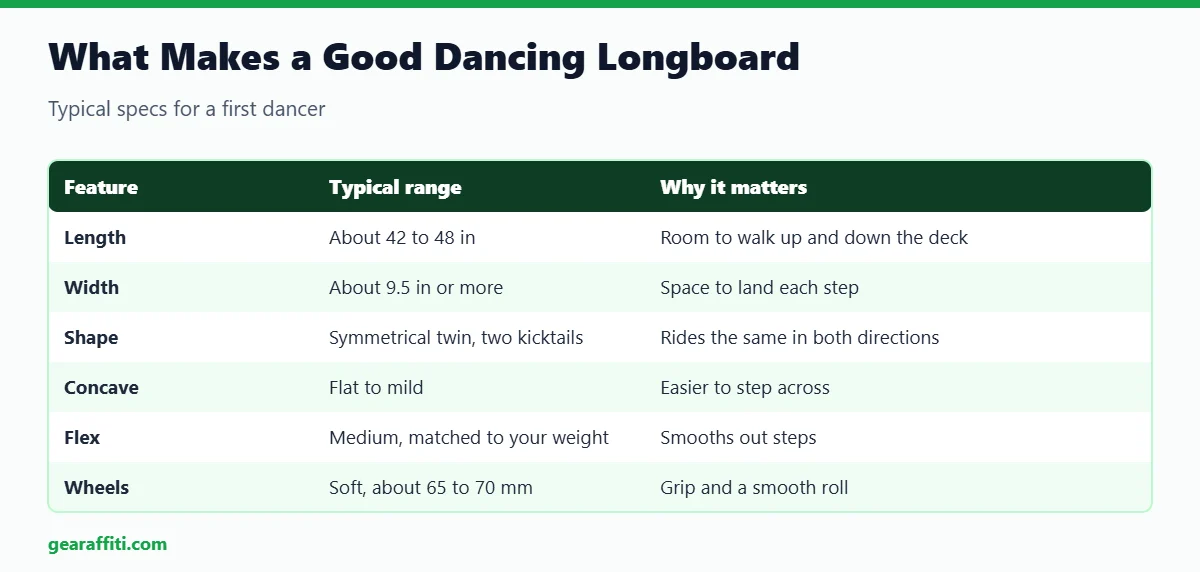
Flex is a personal choice, but many dancers like a medium flex that softens each step. Match the flex to your weight using the maker’s chart. Well-known dancing boards include models from Loaded, whose current range is on the brand’s official site. See dancing longboards on Amazon.
If you are brand new to longboarding, start with our beginner longboard guide and our overview of types of longboards.
Before You Dance: Master the Basics
Dancing builds on everyday riding skills. Before you try your first step, make sure you can push smoothly, carve gently in both directions and, above all, stop confidently. Our guide on how to stop on a longboard covers foot braking and carving to slow down. It also helps to know whether you ride regular (left foot forward) or goofy (right foot forward), because each move starts from your normal stance.
Your First Five Moves
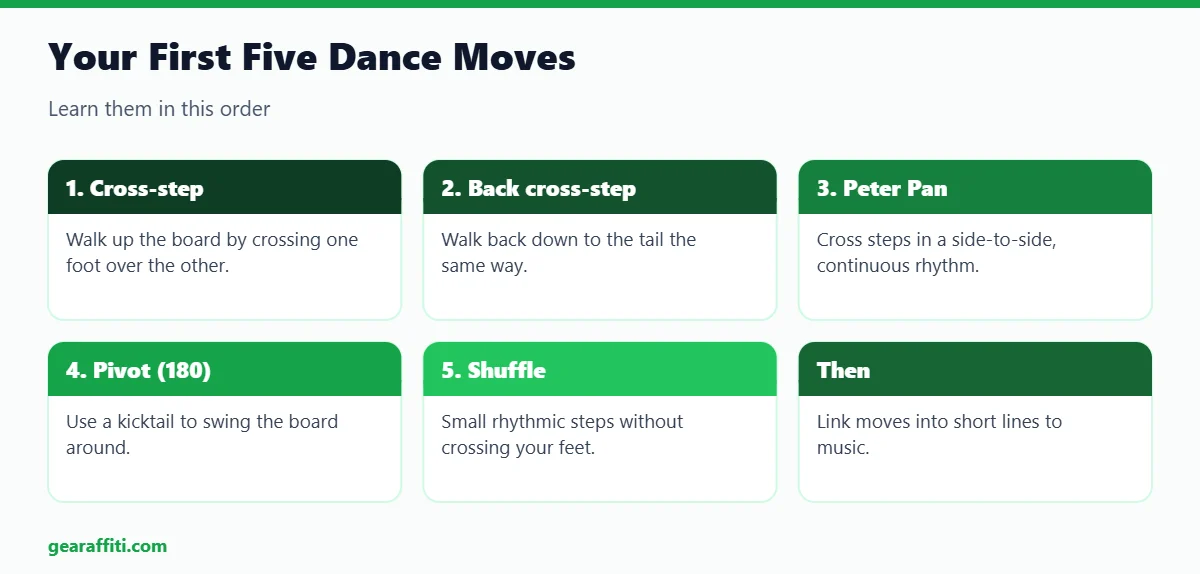
Learn these moves in order. Each one builds on the last, and together they form the foundation of almost every dance line.
1. The cross-step
The cross-step is the signature move of longboard dancing. Start rolling in your normal stance near the tail. Cross your back foot over your front foot and place it further up the board, then bring your other foot forward past it, so you “walk” towards the nose one crossing step at a time. Keep your knees bent and your weight centred over the board. To come back, reverse the steps.
2. The back cross-step
Once you can walk up the board, practise walking backwards towards the tail. It feels awkward at first, but being able to move in both directions is what lets you link moves smoothly.
3. The Peter Pan
The Peter Pan uses crossing steps in a continuous side-to-side rhythm, with your body facing more along the board than in a cross-step. Hold your arms out for balance and keep each step light and even. Rushing or hesitating breaks the flow, so practise slowly until the rhythm feels natural.
4. The pivot
Standing on one kicktail, lift the opposite end slightly and swing the board around 180 degrees. Start with small, slow pivots at very low speed. Pivots let you change direction and are the base for many spins.
5. The shuffle
Shuffles are small, rhythmic steps where your feet move without fully crossing. They are a good way to fill time between bigger moves and to stay balanced while you plan your next step.
Linking Moves Into a Line
A “line” is a sequence of moves performed in one smooth run. Start by linking two moves, such as a cross-step up the board followed by a back cross-step to the tail. Then add a Peter Pan or a pivot. Many dancers practise to music, which makes it easier to find a rhythm. Film yourself from time to time; you will spot habits, such as looking down or standing too upright, that are hard to feel while riding.
Practise Safely
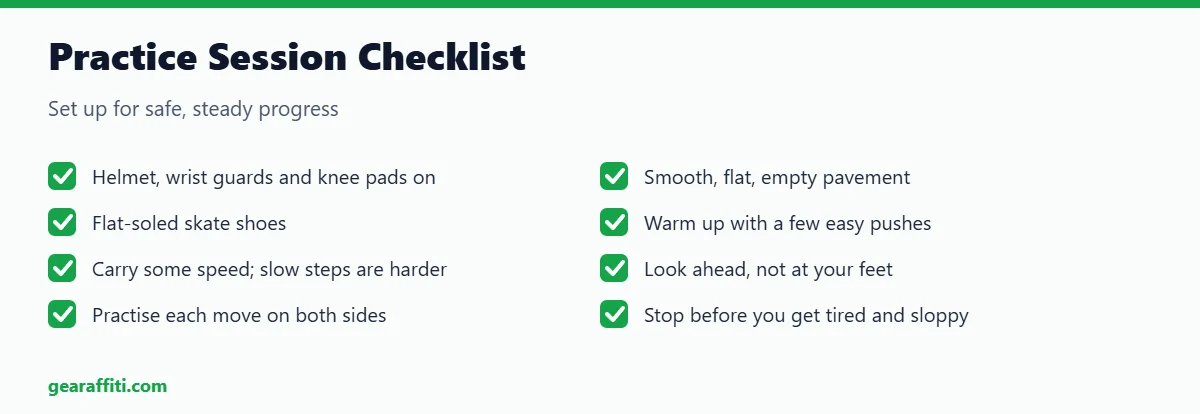
Even at cruising speed, a missed step can send you off the board. Nemours KidsHealth recommends a helmet, wrist guards, elbow pads and knee pads for skateboarders, and suggests learning in smooth areas away from traffic (KidsHealth: Skateboarding safety tips). See our guide to the best skateboard helmets.
Shoes for dancing
Flat, flexible skate shoes give the best board feel. Thick running soles make it harder to feel the deck under your feet, while worn-out soles can slip. Keep laces tucked in so they cannot catch on the grip tape.
Common beginner mistakes
- Riding too slowly: a little speed makes the board more stable; dancing at walking pace is harder.
- Looking at your feet: look ahead and let your feet find the deck.
- Stiff legs: bend your knees to absorb bumps and stay balanced.
- Stepping off-centre: land each step near the middle of the deck so the board does not tip.
- Practising one side only: learn moves from both directions to link lines smoothly.
A Simple Weekly Practice Routine
Progress comes from regular, focused practice rather than long sessions. Two or three sessions a week of about an hour work well for most beginners. Spend the first ten minutes warming up with pushes and gentle carves. Then pick one move to focus on and repeat it until it feels a little easier, practising from both directions. Finish each session by linking the moves you already know into a short line, so you always end on something you can do. Keep a short note of what felt good and what did not; it makes the next session more productive and shows you how far you have come.
Frequently Asked Questions
Can I dance on a regular longboard?
You can practise basic cross-steps on a long cruiser or drop-through board, but short boards and pintails make it hard. A dedicated dancer with more length and width is much easier to learn on.
How long does it take to learn the cross-step?
It varies, but with regular short sessions many riders manage a few clean cross-steps within a couple of weeks. Smooth, confident lines take longer.
Is longboard dancing good exercise?
Yes. Pushing, balancing and stepping work your legs and core, and longer sessions can be quite tiring. It is also a fun way to improve balance and coordination.
What surface is best for dancing?
Smooth, flat pavement such as an empty car park, a quiet promenade or a basketball court. Avoid rough ground, gravel and anywhere with traffic.
Final Thoughts
Longboard dancing is one of the most creative ways to ride. Start with a long, symmetrical board, learn the cross-step, back cross-step and Peter Pan in that order, and practise in short, regular sessions with your safety gear on. Once the basics feel natural, start linking moves into lines and develop your own style. If you also want to try a different board style, read our guide on skateboard vs longboard.

Hi, I’m Emam Hasan — an English teacher and the founder of Anirban Lexicon Center in Mirpur, Dhaka. I run Gearaffiti to share clear, honest buying guides on scooters, skateboards, longboards, bikes and snow gear. Alongside teaching, I work in digital marketing and SEO, and I enjoy turning spec sheets and owner feedback into simple advice anyone can follow.